Eleven months of waiting—nearly 340 days where every week counts. Mare gestation is more than just a waiting game; it requires rigorous management, timely health boosters, and daily observation in the field. To help you structure this period, we have compiled our practical insights in our horse health and prevention advice section.
A successful breeding does not guarantee a vigorous foal eleven months later. From silent embryonic resorption and the risk of twins to skyrocketing nutritional needs in the final trimester, the challenges are real. Understanding each stage allows you to anticipate rather than react, turning the breeder's mental load into a mastered routine.
How long is a horse's gestation period?
The standard rule taught to all enthusiasts is simple: equine gestation lasts 11 months, or approximately 340 days. In practice, expect a range of 320 to 365 days. A slight delay beyond the average is much more common—and far less risky—than a premature birth.
This duration is not set in stone. According to IFCE (French regulatory standards), pregnancies starting in winter are generally longer than those beginning in spring, which are in turn longer than those starting in summer. The mare's age, breed, and body condition also play a role. For jennies, the gestation period can even extend to nearly 12 months.
Before 320 days, the foal may not be fully mature, leading to weakness, respiratory issues, and infection risks. This is why it is critical to record the exact breeding or insemination date to maintain an accurate gestation calendar.
If your mare goes a few days past her expected due date, there is no immediate cause for concern; she may simply be carrying a colt.
Veterinary epidemiological studies, including the reference prospective analysis published on PubMed (Bosh et al.), confirm that the gestation period for a male foal is on average 2 to 3 days longer than for a female. This phenomenon is explained by specific endocrine interactions from the male fetus that slightly delay the hormonal signal triggering labor in the dam.
Key stages of gestation, month by month
Fetal development follows a clear progression, with milestones that are easy to track for those who know what to look for.
First Trimester (1 to 3 months). The transition from the embryonic to the fetal stage marks the beginning of organ formation. At 1 month, the embryo is about 1 cm long. By the second month, the placenta firmly attaches to the uterine wall—a sensitive stage. At 45 days, sex differentiation is complete. By 3 months, the fetus is approximately 14 cm long.
Second Trimester (4 to 6 months). Organs are well-formed. By 100 days, the hooves are fully developed. At 5 months, the fetus is about the size of a rat (30 to 35 cm) and weighs nearly 2 kg. By 6 months, it measures about 50 cm and weighs nearly 5 kg. Weight gain accelerates rapidly from here.
Late Gestation (7 months to foaling). The pace quickens: the fetus will reach about one meter in length and a birth weight of around 50 kg. The spleen develops at 9 months, and the body becomes covered in hair. The final two months are dedicated to organ maturation, particularly the lungs.
Confirming pregnancy and managing gynecological follow-up
The gold standard remains transrectal ultrasound, performed by your veterinarian as early as 14 days after insemination. This is also the only way to detect twin pregnancies, which must be reduced quickly as the mare's uterus is not designed to support two placentas.
A check-up around 45 days confirms proper implantation. The real challenge for the breeder is not just knowing these dates, but ensuring they are never missed across an entire herd.
This is precisely where our platform lightens the load: the automatic IFCE/SIRE import retrieves the complete breeding history of your broodmares, and our Foalia foaling index calculates a vigilance score, triggering alerts at the right time.
Nutrition and care for the broodmare
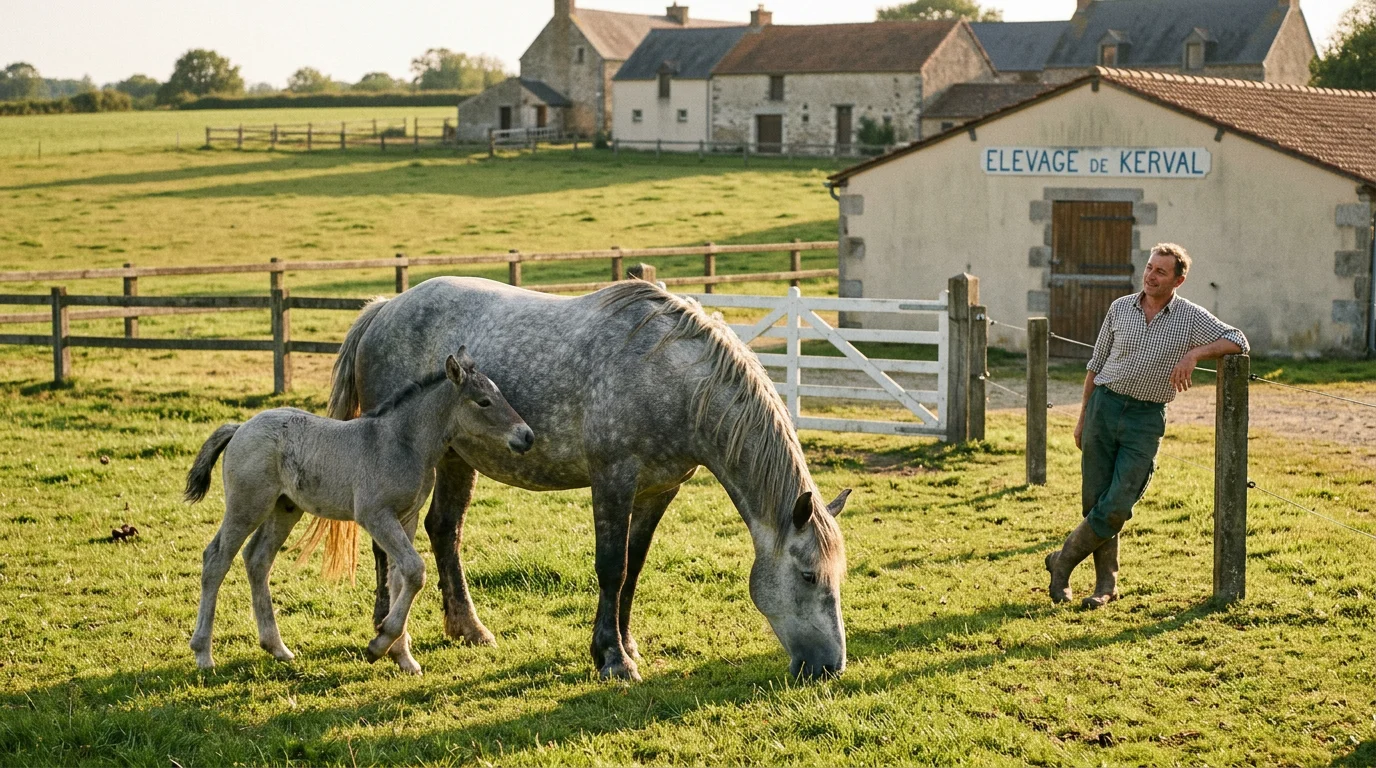
During the first five months, nutritional needs remain nearly identical to those of an open mare. Everything changes at the 6th month: the foal's rapid growth drives up energy and protein requirements. However, the space occupied by the fetus reduces the mare's intake capacity.
The solution follows one rule: higher energy density in smaller volumes. Quality hay and pasture form the base; a vitamin and mineral supplement (VMS) ensures essential intake. In the final trimester, a concentrate formulated for broodmares—rich in fats rather than starch, and supplemented with vitamins A, D, and E—completes the ration.
Weight gain is significant: according to IFCE guidelines, it represents 6.4% to 8% of body weight over the last three months, or 40 to 50 kg for a 550 kg mare. Regarding exercise, light work is possible in early pregnancy, but intensity should be reduced by the 4th or 5th month. As field practitioners note, a calm, well-fed mare navigates her eleven months much better.
Research by Dr. Pascale Chavatte-Palmer’s team (INRAE / École Nationale Vétérinaire d'Alfort) has shown that insufficient energy intake in late gestation tends to prolong the pregnancy by an average of 4 days, while compromising the foal's birth weight and placental development.
Risks to monitor during gestation
Each phase has its pitfalls. During the first three months, loss can go completely unnoticed: this is early embryonic resorption. Beyond three months, it is classified as an abortion, involving the expulsion of the fetus.
Infectious causes are a major concern. Equine Herpesvirus (EHV-1) can cause late-term abortions, between 9 and 11 months, sometimes without warning signs. This underscores the importance of vaccinating your broodmares at the 5th, 7th, and 9th months. Placentitis or an unreduced twin pregnancy are also on the list of risks.
A tetanus and equine influenza booster, 4 to 6 weeks before foaling, strengthens the antibodies passed to the foal via colostrum. We detail these protocols in our guide Equine Influenza: Risks and Precautions. Certain signs require an immediate call to your veterinarian: abnormal vaginal discharge, fever, premature lactation, or colic.
Preparing for a smooth foaling
Move your mare to her foaling area 4 to 6 weeks before the due date: a large, clean stall with abundant straw bedding, or a secure, weather-protected paddock. Acclimatization time is important.
Signs of imminent foaling appear late in the term: udder development starting at 8 months, colostrum secretion in the final days, and relaxation of the pelvic ligaments. Be aware that some mares show almost no signs. Most foal in the middle of the night or early morning, so be prepared for a few sleepless nights.
The expulsion phase is short: the foal should emerge front feet first, hooves pointing down. According to veterinary resources, a mare in a calm environment needs only 15 to 20 minutes to deliver. If labor is stalled for more than 20 to 30 minutes, call your vet immediately. The placenta should be expelled within 3 hours; keep it for inspection.
Key takeaways for a successful gestation
Horse gestation is neither a pathology nor a mere waiting period: it is an eleven-month window that rewards anticipation. Record the breeding date, follow the ultrasound and vaccination schedule, adjust the ration starting at the 6th month, and increase monitoring from the 9th month onward. In France, where breeding requires strict traceability, rigorous tracking makes the difference between a reactive approach and a healthy, expected foal.
Take action with Foalia
Tracking heat cycles, dating every pregnancy, never missing a vaccination booster, and maintaining a compliant breeding register: for an entire herd, this mental load quickly becomes unmanageable with pen and paper. This is exactly the daily grind we want to simplify for breeders and owners.

With automatic IFCE/SIRE import, predictive foaling indices, and multi-channel foaling alerts, discover our reproduction tracking and foaling alert platform, designed to manage your broodmares from the field and free up your mental load.
Frequently Asked Questions
How long does a mare's gestation last?
On average 11 months, or a range of 320 to 365 days. A slight delay is common and usually harmless, whereas birth before 320 days exposes the foal to risky immaturity.
When can pregnancy be confirmed?
As early as 14 days after insemination, via transrectal ultrasound. This early exam is also the only way to detect a twin pregnancy, which must be reduced promptly.
Can you ride a pregnant mare?
Light work is possible during the first few months. From the 4th or 5th month, it is recommended to scale back; gentle activity like walking remains beneficial almost until the due date.
When should I adjust the broodmare's diet?
Nutritional needs remain stable for the first five months, then increase significantly starting at the 6th month. In the final trimester, prioritize a high-energy, protein-rich concentrate in small, frequent meals.
How can I avoid missing follow-up deadlines for multiple mares?
Centralizing breeding, ultrasound, and vaccination dates prevents costly oversights. Our foaling index and automated alerts calculate these deadlines and notify you at the right time, eliminating the need for manual registers.