A single horse fly bite or a reused needle can instantly put your entire barn under state government quarantine. Equine Infectious Anemia (EIA) is one of the most serious regulatory threats in horse management: it remains incurable, has no approved vaccine, and carries federal and state mandates for lifetime isolation or euthanasia of carrier horses. For any breeder or ranch manager, an outbreak jeopardizes not only individual horses but also your facility's operational compliance, movement privileges, and marketability. Understanding this virus, recognizing its clinical forms, and establishing bulletproof farm biosecurity is essential, as detailed in our guide on Equine Infectious Diseases: Preventing and Recognizing Health Risks.
While federal and state control programs have dramatically reduced EIA prevalence in North America over recent decades, sporadic outbreaks still occur annually across various regions. According to reports monitored by the USDA Animal and Plant Health Inspection Service (APHIS) and the American Association of Equine Practitioners (AAEP), unmonitored herds and illegal movement of unscreened equines present a constant risk. For breeders and barn managers, vigilant disease prevention is a daily operational necessity.
An Ancient Lentivirus with Lifelong Persistence
EIA is caused by an equine lentivirus belonging to the Retroviridae family—the same viral retrovirus family as HIV in humans. Once infected, an equine remains a carrier for life: it becomes a permanent viral reservoir capable of spreading the virus to nearby horses whenever bloodsucking vectors are active. This persistent viral integration into host cells is why no cure or vaccine exists.
The disease exclusively affects equids, including horses, ponies, donkeys, mules, and hinnies. It cannot infect humans or non-equine livestock. First documented in the 19th century, EIA remains a regulated disease worldwide. In the United States, systematic testing via Coggins certificates before interstate transport, shows, and sales has suppressed national infection rates, but wild vector populations and untested horse pools keep the threat alive.
How Equine Infectious Anemia Spreads on Your Ranch
Transmission occurs exclusively through the transfer of infected blood. The primary natural vectors are hematophagous (biting) insects, particularly horse flies (Tabanids) and deer flies. These large biting flies act as mechanical vectors: when interrupted while feeding on an infected horse, they carry residual blood on their mouthparts directly to a neighboring horse. Unlike equine influenza, EIA is not spread through respiratory droplets or airborne transmission.
Two human-controlled vector routes demand strict protocols in barn and breeding management. First, iatrogenic transmission via contaminated equipment: reusing a needle, syringe, dental float, or surgical instrument without medical sterilization easily transmits infectious blood doses between animals. Second, transplacental transmission from an infected broodmare to her foal in utero or via colostrum. Sterile reproductive practices and clean AI equipment are imperative. These identical hygiene standards safeguard against other major foal pathogens, as explored in our article on Rhodococcus equi in foals: symptoms and preventive approach.
Recognizing Symptoms and Clinical Forms
A major challenge in controlling EIA is that infected animals often display subtle or zero overt signs. Many chronically infected horses act as asymptomatic carriers while continuing to circulate dangerous viral loads during vector season. When clinical signs appear, the disease progresses through several recognized stages:
- Acute Form: High fever (104°F to 108°F), sudden severe depression, anorexia, rapid heart rate, severe anemia, and petechial hemorrhages on mucous membranes. Acute EIA can cause fatal organ failure within days.
- Subacute Form: Intermittent moderate fever, recurring weakness, and variable recovery periods that temporarily mimic healthy recovery.
- Chronic Form: Progressive weight loss, muscle wasting, lethargy, ventral edema (swelling along the chest and abdomen), severe anemia, and recurrent fever spikes over several months.
- Inapparent/Latent Form: The horse exhibits no visible symptoms, appears healthy, yet carries the virus for life and acts as a reservoir for fly transmission.
Recurrent spikes in body temperature, unexplained weight loss, stocking up or ventral edema, and anemia should prompt immediate veterinary consultation. Because clinical symptoms overlap with other diseases, laboratory diagnostics are required to confirm EIA.
The Coggins Test: The Gold Standard Diagnostic
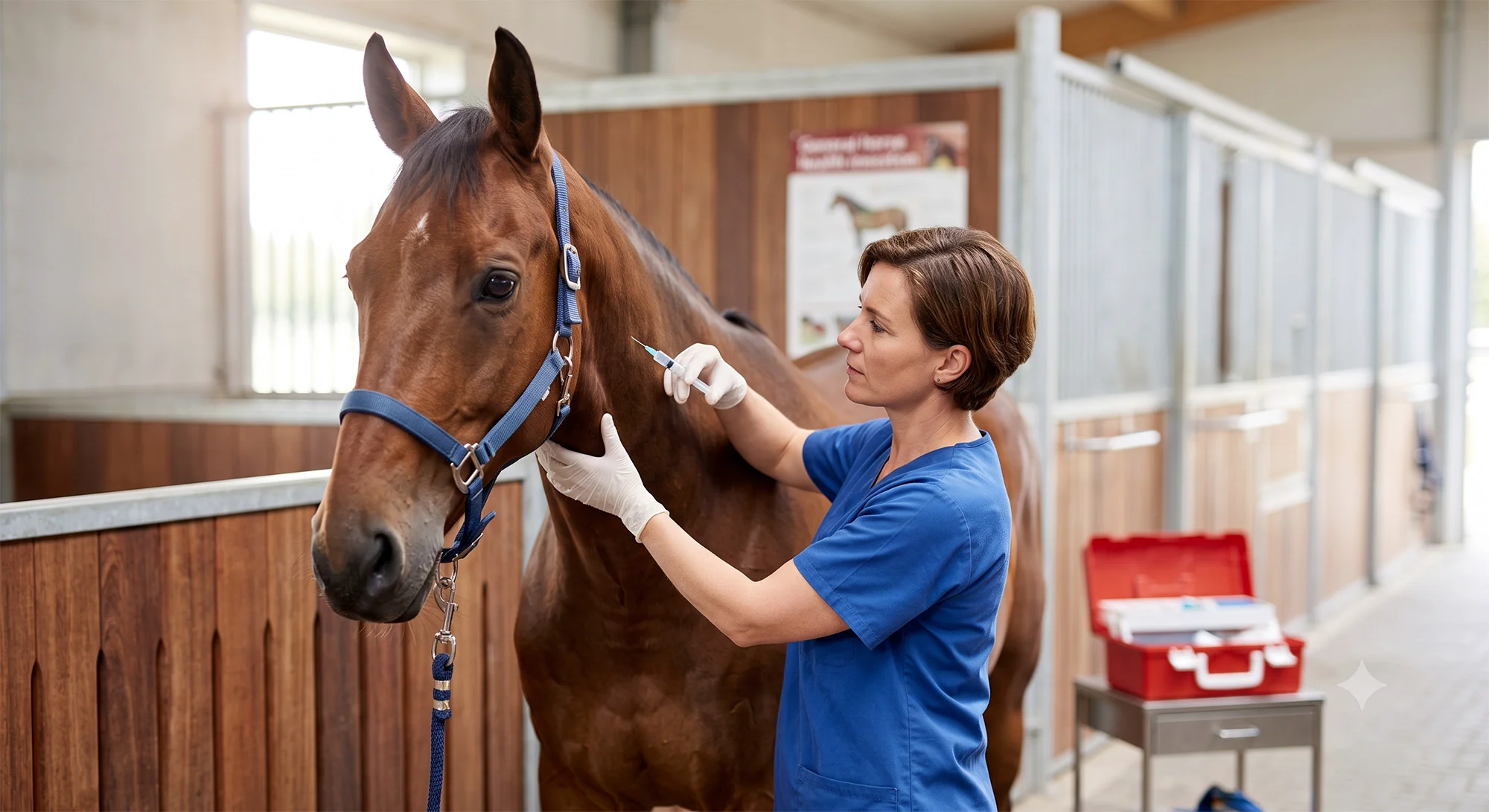
When EIA is suspected or routine health certification is required, a USDA-accredited veterinarian draws a blood sample for an official diagnostic test. The standard testing method is the Coggins test—an Agar Gel Immunodiffusion (AGID) assay developed by Dr. Leroy Coggins in 1970. Enzyme-Linked Immunosorbent Assays (ELISA) are also approved for faster initial screening, though positive ELISA results must be confirmed by a standard AGID Coggins test.
An official negative Coggins certificate (USDA Form VS 10-11 or an approved electronic equivalent) is a universal legal requirement across the US equine industry. State laws mandate a recent negative Coggins test (typically within 6 to 12 months) for interstate movement, public horse shows, breeding farm entry, boarding facilities, and public equine sales. Maintaining organized digital records of all testing dates and certificate numbers is vital when managing multiple stallions, broodmares, or performance horses.
Regulatory Consequences: Quarantine and Mandatory Control
Confirmed cases of Equine Infectious Anemia carry severe regulatory mandates under federal and state livestock health laws. Because no treatment or vaccine exists, state animal health officials enforce strict quarantine and disease control protocols upon receiving a positive laboratory result.
Under USDA guidance, any horse confirmed positive for EIA must be permanently isolated or euthanized to prevent vector transmission to surrounding facilities. If isolation is permitted by the State Veterinarian, the reactor horse must be kept in a vector-proof enclosure located at least 200 yards away from any other equines for the rest of its natural life—a requirement that is often impractical for commercial barns. Furthermore, the entire origin farm is quarantined, and all contact horses undergo mandatory testing and re-testing before movement restrictions can be lifted, creating severe financial and operational disruptions.
Farm Biosecurity: Preventive Management Practices
With no medical cure available, protecting your herd depends entirely on strict operational hygiene and proactive ranch management. Core biosecurity practices include:
- Strict single-use needle policies: Use a brand-new sterile needle and syringe for every single injection or blood draw, without exception.
- Integrated fly control: Eliminate standing water sources, maintain clean manure management, utilize fly traps, apply EPA-approved insecticides/repellents, and turn horses out during low vector activity hours.
- Quarantine protocols: Isolate all incoming horses and require a negative Coggins certificate prior to arrival on the property.
- Regular herd testing: Schedule annual or semi-annual Coggins testing for all resident horses, broodmares, and stallions.
This disciplined tracking philosophy applies to all contagious equine diseases, including preventable conditions, as detailed in our guide on Equine Influenza: Symptoms, Vaccination, and Prevention. Centralizing your herd's health records, Coggins certificate expiration dates, and movement logs ensures rapid response capability during any health alert. Our connected equine health record and automated barn management tool simplify this process, keeping your paperwork audit-ready and fully compliant.
Key Takeaways for Ranch and Barn Managers
Equine Infectious Anemia cannot be cured, but it can be prevented through rigorous ranch biosecurity and compliance. Single-use needles, proactive biting fly management, and up-to-date Coggins testing protect both your horses and your business reputation. In an industry where a single positive test triggers immediate state quarantine and severe regulatory action, having instant access to certified health histories is essential protection for your facility.
Take Action with Foalia
Tracking Coggins test expiration dates, managing vaccination schedules, updating breeding records, and maintaining complete health compliance across a herd can create significant administrative burdens for breeders and barn managers. When disease prevention depends on flawless documentation, having an intuitive software tool changes everything.
With our equine management platform featuring digital health records and automated registers, you can manage your horses' complete health profiles, schedule testing reminders, track reproductive histories, and stay fully compliant in real time. Automated reminders and centralized data allow you to spend less time on paperwork and more time with your horses.
Frequently Asked Questions
Can Equine Infectious Anemia infect humans?
No. EIA only affects equids, including horses, donkeys, mules, and hinnies. It poses no infection risk to humans or non-equine farm animals.
Is there a vaccine or treatment for EIA?
No. There is currently no approved treatment or vaccine for EIA due to the virus's rapid genetic mutation rate. Prevention relies exclusively on fly control, needle hygiene, and diagnostic testing.
What happens if a horse tests positive for EIA in the United States?
Confirmed EIA cases must be reported immediately to the State Veterinarian and the USDA. The facility is placed under quarantine, and the positive horse must be humanely euthanized or permanently isolated in a vector-proof area at least 200 yards from other horses.
How often does a horse need a Coggins test?
Most states require a negative Coggins test within 12 months for interstate travel, public events, boarding, and sales. Some facilities or breeding stallions require testing within 6 months. Always check specific state and facility entry requirements.
How does Foalia assist with EIA record-keeping?
Foalia securely stores Coggins test dates, attaches digital test documents, and alerts you before certificates expire, ensuring your herd remains compliant for travel, competition, or breeding operations.