Cycle length, timing of ovulation, foal heat: a sound understanding of the mare's estrous cycle is what makes or breaks a breeding season. Artificial insemination with cooled or frozen semen is now the norm on most breeding farms, and it requires knowing exactly where each mare stands in her cycle. This article reviews the physiological benchmarks, ultrasound monitoring and the management of foal heat.
It complements our guide to broodmare reproductive monitoring, which focuses on the veterinarian's work.
The mare's estrous cycle: key benchmarks
The mare alternates between two phases: estrus, during which she accepts the stallion, and diestrus, during which she rejects him. According to the IFCE, the French Horse and Riding Institute, the cycle lasts 21 days on average, with wide variation: estrus lasts from 2 to 15 days depending on the mare and the season, longer in spring and shorter in summer.
Diestrus is far more consistent: about 14 days, whatever the length of the preceding estrus. During estrus, a dominant follicle develops on the ovary; after ovulation it becomes a corpus luteum, whose progesterone keeps the mare out of heat and, if fertilization occurs, maintains the pregnancy.
Breeding season: the return of cyclicity
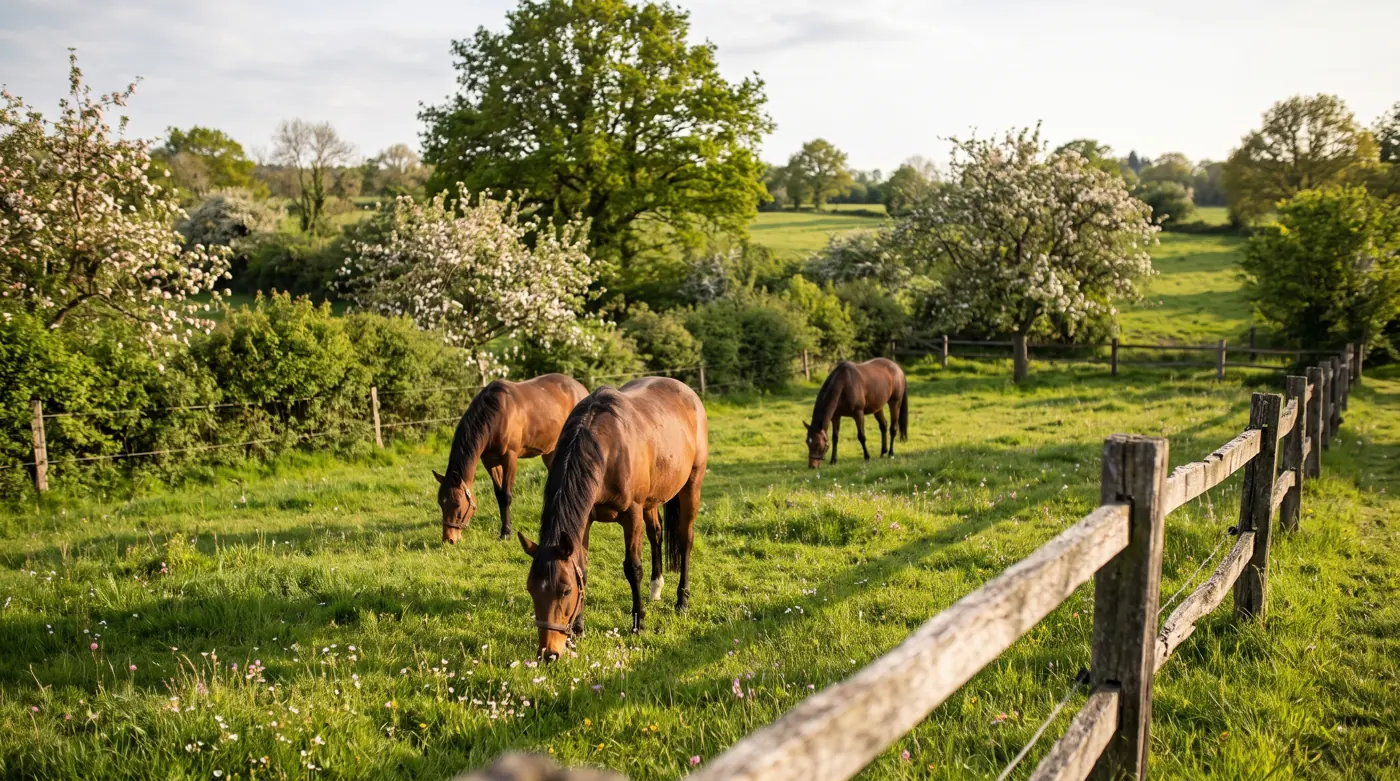
The mare is a long-day seasonal breeder. Most mares stop ovulating between October and December and resume regular cycles in spring, often in April or May, after a transition period; some keep cycling through the winter. This transition is misleading: long, irregular heats and follicular growth without ovulation.
To advance the season, light therapy starts in December, about 70 days before the desired breeding date, as detailed in the IFCE recommendations on artificial lighting. The protocol is set with your veterinarian.
Ultrasound monitoring, the standard for artificial insemination
With artificial insemination, behavior alone is not enough: the veterinarian follows follicular growth, the uterus and the cervix by ultrasound. It is the change from one exam to the next that places the mare in her cycle and allows the insemination to be scheduled.
When the follicle is ready, ovulation can be induced to match the timing of semen delivery. The injection is given to a mare in heat whose follicle usually measures 35 mm or more (slightly less in ponies), and ovulation occurs on average 36 hours later, according to published data on ovulation induction. An injection given too early can compromise ovulation: the decision rests with the veterinarian.
The timing of insemination depends on the type of semen. Sperm survive about 48 hours on average in the mare's reproductive tract, while the oocyte lives only a few hours after ovulation. With cooled semen, mares are therefore inseminated before ovulation, with shipments planned ahead. With frozen semen, sperm survival is much shorter: exams become more frequent and the veterinarian inseminates as close to ovulation as possible, sometimes just after.
After insemination, the first ultrasound, between 14 and 16 days, confirms pregnancy and also detects twins early, while the veterinarian can still intervene simply. For what comes next, our guide to mare gestation takes over.
Teasing, as a complement
Teasing over a rail remains useful alongside ultrasound, especially to spot a return to heat, and it is still the basis of monitoring for live cover. The signs of estrus are well known: raised tail, winking of the vulva, squatting stance, urination in small amounts; so are the signs of rejection: the mare squeals, swishes her tail, pins her ears and kicks.
Without ultrasound monitoring, the date of the first rejection is the reference point, rather than counting 21 days from the start of heat. In these mares, the IFCE observes that ovulation occurs in 69% of cases during the last two days of heat and in 11% of cases on the day of the first rejection, and the mare can be teased again 13 to 14 days later. Only an ultrasound pregnancy check can then give a definite answer.
In the middle of the breeding season, a mare that shows no heat for three weeks should be examined: pregnancy, ovarian inactivity, persistent corpus luteum or silent ovulations. Since some treatments can cause abortion, none should be considered before pregnancy has been ruled out.
After foaling: foal heat
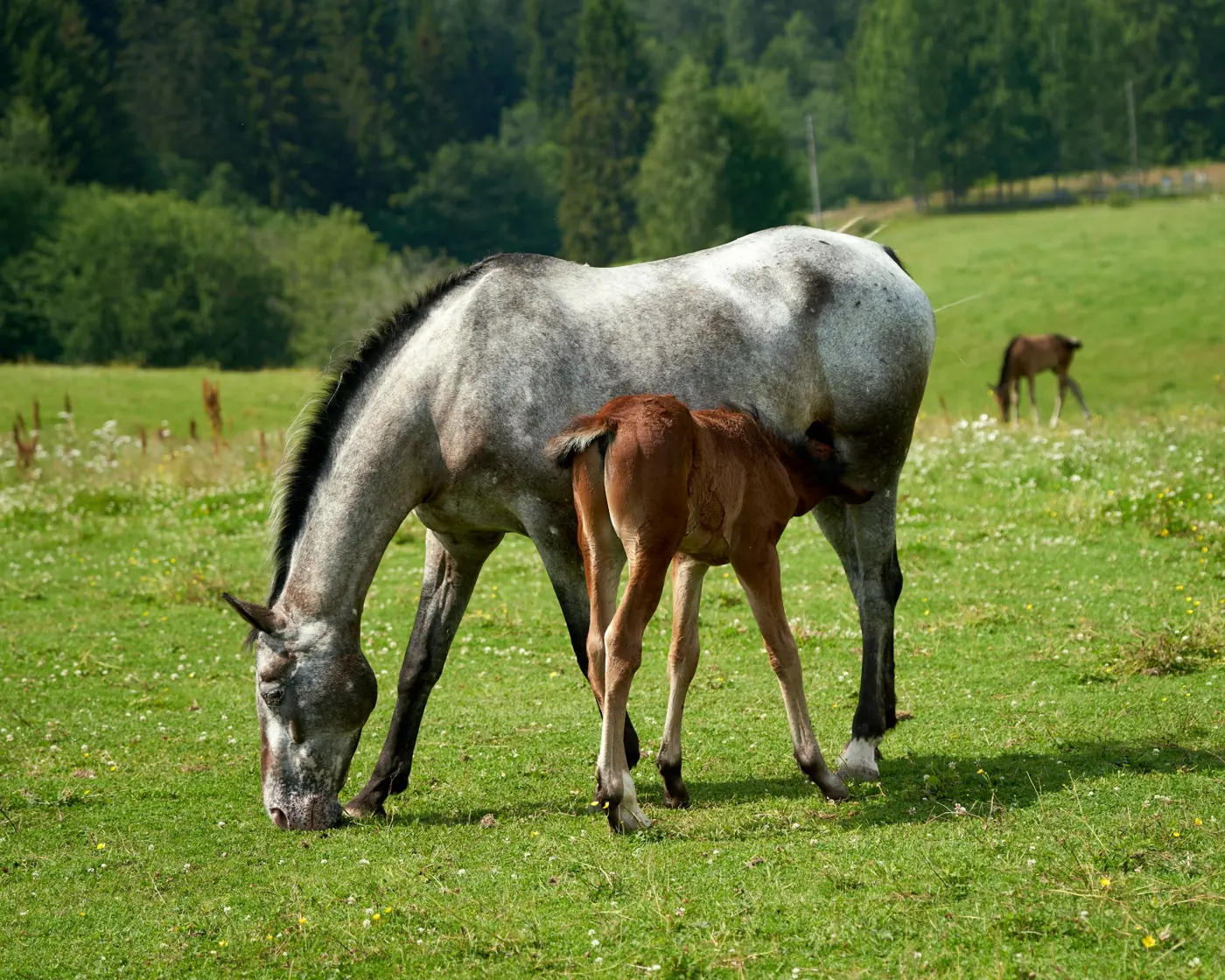
Foal heat begins 5 to 12 days after foaling and lasts 2 to 7 days, 4 days on average, as the IFCE points out.
Its fertility depends on when ovulation occurs. Before day 10, uterine involution is unlikely to be complete and the risk of early embryonic loss increases. After day 12, if foaling went without complications, fertility is similar to that of later cycles. Even if it is not used for breeding, a well-dated foal heat helps the veterinarian predict and plan the next cycle.
For the foal, this period often coincides with "foal heat diarrhea", between 7 and 14 days of age. It is common and usually mild, but close monitoring of the foal is essential.
An accurate history for every mare
For each mare and each cycle, the data the veterinarian needs are always the same: mare with or without a foal at side, body condition, start and end of heat, ultrasound findings, any induction and its time, insemination (stallion, type of semen) and pregnancy check result. Season after season, this history builds the profile of each broodmare: long or short heats, obvious or subtle signs, response to induction.
The main risk is entering data twice: a date copied from a notebook into a spreadsheet, then sent by text message, often ends up wrong. The principles for keeping breeding records up to date apply here: record it right away, in one place.
That is the approach taken in Foalia. Breeding plans are set up mare by mare; once the insemination is confirmed, pregnancy monitoring starts with its ultrasound schedule (day 14, day 30, day 45), which can be adapted to each farm's routine, and a reminder arrives the day before each check. The time of the induction injection is recorded in the mare's file.
Take Action with Foalia
Foalia brings together your breeding plans, inseminations, ultrasound reminders and pregnancy monitoring for each mare, on computer and phone. Free for one mare, no commitment.
Get ready for your next breeding season with our horse breeding management app.
Frequently Asked Questions
How long is a mare's estrous cycle?
The cycle lasts 21 days on average, with wide variation between mares and seasons. Estrus lasts from 2 to 15 days, while diestrus is more stable, around 14 days.
How can you tell if a mare is in heat?
Ultrasound by the veterinarian is the reference method: it shows the dominant follicle and the uterus. Teasing is a useful complement, provided all of the mare's reactions are read together rather than a single sign.
When should a mare be inseminated?
With cooled semen, before ovulation, because sperm survive about two days while the oocyte lives only a few hours. With frozen semen, the veterinarian inseminates as close to ovulation as possible, sometimes just after, based on ultrasound exams.
When does a mare come back into heat after foaling?
Foal heat appears 5 to 12 days after foaling and lasts 4 days on average. An ovulation before day 10 is less fertile: whether to breed on it is decided with the veterinarian.
What if a mare does not come back into heat?
In the middle of the breeding season, after three weeks without heat, she should be examined by the veterinarian: pregnancy, ovarian inactivity, persistent corpus luteum or silent ovulations. No treatment should be considered before pregnancy has been ruled out.


